White tea · Blend with Bergamot
White Earl Grey
A 250 ml cup of White Earl Grey has about 18 mg of caffeine.
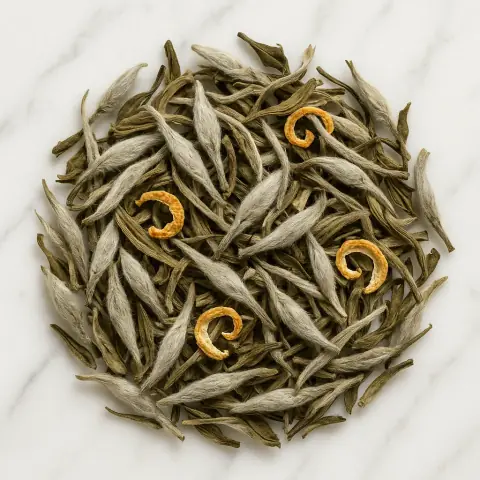
Delicate white tea infused with bergamot oil, offering citrusy elegance with the subtle sweetness of white tea.
 How to brew
| Leaf | Water | Temperature | Time | Infusions | |
|---|---|---|---|---|---|
| Western | 3.5 g | 250 ml | 80°C / 176°F | 3 min | 4 |
| Gong Fu | 5 g | 100 ml | 80°C / 176°F | 20 s + | 6 |
How to brew White Earl Grey
- Heat water to 80 °C (176 °F).
- Add 3.5 g of White Earl Grey for 250 ml of water.
- Steep for 3 min, then strain.
- Re-steep the same leaves up to 3 more times.
About this tea
White Earl Grey represents a refined evolution of the classic Earl Grey, replacing the traditional black tea base with delicate white tea to create a lighter, more nuanced bergamot experience. This modern interpretation emerged in the early 2000s as specialty tea blenders sought to offer the beloved citrus-floral character of bergamot in a gentler format, appealing to those who find traditional Earl Grey too astringent or caffeinated.
The blend typically uses high-quality white tea - often White Peony (Bai Mudan) or sometimes Silver Needle - as its foundation, scented with oil from the bergamot orange (Citrus bergamia), a fragrant citrus fruit grown primarily in Calabria, Italy. The white tea base provides natural sweetness and a smooth, silky texture that allows the bergamot's complex aromatics to shine without competition from tannins. Quality blends use cold-pressed bergamot oil rather than synthetic flavoring, resulting in more authentic citrus-floral notes.
The flavor profile achieves remarkable balance: the bergamot's distinctive citrus-floral character - notes of orange blossom, lavender, and Earl Grey's signature 'cologne-like' quality - floats atop the white tea's subtle sweetness and hay-like undertones. Unlike black tea Earl Grey, there's no astringency to cut through, creating a seamless, ethereal drinking experience. The finish is clean and refreshing with lingering citrus notes. Well-made versions exhibit the white tea's natural honey sweetness complementing the bergamot's brightness.
Brewing recommendations: Use 1 heaping teaspoon (3-4g) per 250ml cup with water at 80°C (176°F), steeping for 3-4 minutes. Lower temperatures than traditional Earl Grey preserve the delicate white tea base and prevent the bergamot from becoming bitter. Avoid boiling water which can destroy subtle flavors. The tea can be re-steeped 3-4 times, though bergamot intensity diminishes with each infusion while the white tea character becomes more prominent.
Perfect for afternoon tea when you desire Earl Grey's sophistication without the boldness. Pairs beautifully with citrus desserts, lemon cakes, shortbread, scones with clotted cream, and delicate pastries. Also excellent with light finger sandwiches and macarons. The low caffeine content (approximately 18mg per cup) makes it suitable for late afternoon or early evening enjoyment. An ideal choice for Earl Grey lovers seeking a gentler, more refined experience.
Use cooler water (80°C/176°F) than traditional Earl Grey to preserve the delicate white tea base. Bergamot intensity is strongest in the first 2 infusions; later steeps emphasize the white tea's natural sweetness. Excellent cold-brewed overnight for a smooth, citrus-forward result.
Caffeine, in context
Per 250 ml cup, brewed as directed.
Flavor profile
- bergamot
- citrusy
- delicate
- sweet
- antioxidants
- relaxation
- mood boost
- aromatherapy
Pairs with
- citrus desserts
- scones
- shortbread
- light pastries
Similar teas



Frequently asked questions
Can you re-steep White Earl Grey?
Yes. White Earl Grey gives 6 good infusions. Start at 20 seconds and give each later round a little longer.
How much caffeine is in White Earl Grey?
18 mg per 250 ml cup. Low caffeine.
What water temperature does White Earl Grey need?
80°C / 176°F. Hotter water pulls out bitterness; cooler water under-extracts the leaf.
Every infusion gets its own clock
Teafinity keeps the temperature, leaf ratio and steeping schedule ready, rings while the phone is in your pocket, and logs the session. 30 teas are free on iPhone and Android.

