Pu-erh tea · Yunnan, China
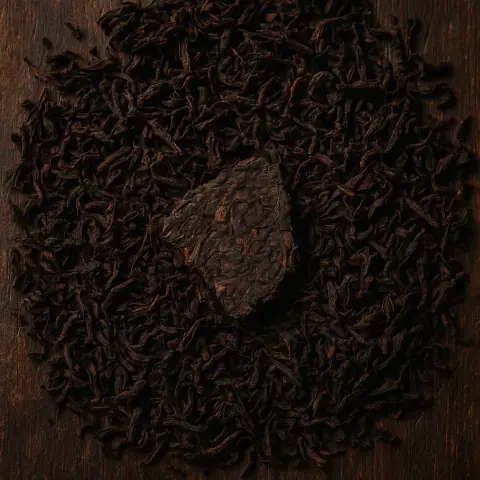
Shou Pu-erh (Ripe)
A 250 ml cup of Shou Pu-erh (Ripe) has about 30 mg of caffeine.
Aged and fermented dark tea with earthy, smooth flavor and deep reddish-brown color.
 How to brew
| Leaf | Water | Temperature | Time | Infusions | |
|---|---|---|---|---|---|
| Western | 3 g | 250 ml | 100°C / 212°F | 1 min | 4 |
| Gong Fu | 6 g | 100 ml | 100°C / 212°F | 10 s + | 10 |
How to brew Shou Pu-erh (Ripe)
- Heat water to 100 °C (212 °F).
- Add 3 g of Shou Pu-erh (Ripe) for 250 ml of water.
- Steep for 1 min, then strain.
- Re-steep the same leaves up to 3 more times.
About this tea
Shou (ripe or cooked) Pu-erh represents a modern innovation in ancient tea tradition, developed in 1973 at Kunming Tea Factory to meet demand for aged tea flavors without the decades-long wait. This accelerated fermentation process, called 'wo dui' (wet piling), mimics natural aging through controlled microbial fermentation, creating in months what traditionally took decades.
The production process is fascinating: after initial processing, maocha (raw pu-erh material) is piled, moistened, and covered, creating conditions for beneficial microorganisms to transform the tea. Temperature and humidity are carefully monitored as the pile ferments for 45-60 days, turned regularly to ensure even fermentation. The tea is then dried and often compressed into cakes (bing), bricks (zhuan), or other traditional shapes. This process creates entirely new compounds not found in other teas.
The flavor profile is unique and polarizing: deep, earthy notes reminiscent of forest floor, mushrooms, and rich soil dominate. Well-made shou exhibits smooth, thick texture with no astringency, sweet undertones of dates or dark molasses, and what Chinese tasters call 'chen wei' (aged flavor). Poor quality shou can taste fishy or moldy, while premium versions offer complex layers of dark chocolate, leather, and minerals. The liquor is deep burgundy to coffee-black.
Brewing recommendations: Rinse leaves with boiling water for 5-10 seconds to awaken them and remove any storage flavors. Use 1 tablespoon (5g) per 250ml cup with boiling water (100°C/212°F), steeping for 1 minute. For gongfu style, use 5-8g per 100ml, steeping 20-30 seconds initially. Can yield 10-20 infusions. Shou pu-erh is very forgiving and won't become bitter with long steeping.
Traditionally drunk after heavy meals in China, where it is the standard end to a rich table. Best enjoyed without additions to appreciate its complexity. Pairs excellently with dim sum, rich meats, and dark chocolate. Many drink it daily, all year round. The earthy character makes it an acquired taste that often becomes an obsession.
Caffeine, in context
Per 250 ml cup, brewed as directed.
Flavor profile
- earthy
- smooth
- woody
- mushroom
- digestion
- cholesterol
- weight management
- probiotics
Pairs with
- rich foods
- dim sum
- dark chocolate
- nuts
Similar teas



Frequently asked questions
Can you re-steep Shou Pu-erh (Ripe)?
Yes. Shou Pu-erh (Ripe) gives 10 good infusions. Start at 10 seconds and give each later round a little longer.
How much caffeine is in Shou Pu-erh (Ripe)?
30 mg per 250 ml cup. Medium caffeine.
What water temperature does Shou Pu-erh (Ripe) need?
100°C / 212°F. Hotter water pulls out bitterness; cooler water under-extracts the leaf.
Every infusion gets its own clock
Teafinity keeps the temperature, leaf ratio and steeping schedule ready, rings while the phone is in your pocket, and logs the session. 30 teas are free on iPhone and Android.

